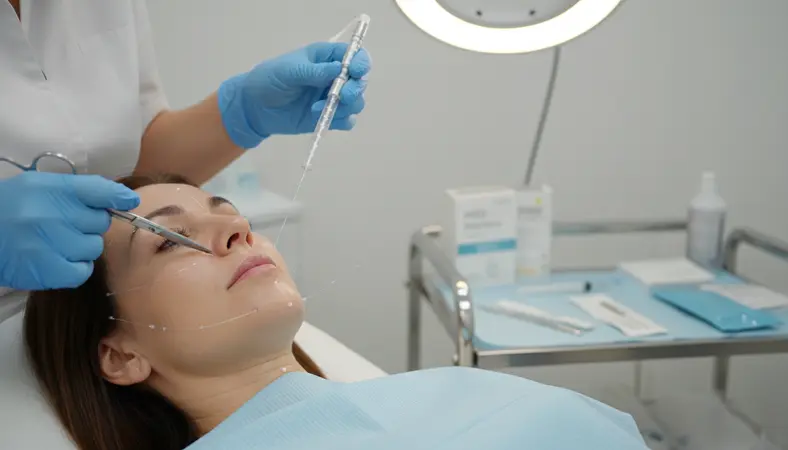
PDO threads and dermal fillers both deliver rejuvenation without a scalpel, but they achieve it through entirely different mechanisms. Threads physically lift and reposition sagging tissue while stimulating new collagen along their path. Fillers add volume to replace what aging has taken away. Choosing the right treatment, or the right combination of both, depends on understanding exactly what each one does best and where it falls short.
This guide provides a thorough comparison covering mechanism of action, treatment areas, results timeline, longevity, cost, recovery, and candidacy so that both practitioners and patients can make informed decisions about their treatment plans.
How Each Treatment Works
PDO Threads: Lift and Stimulate
PDO (polydioxanone) threads are biocompatible, absorbable sutures inserted beneath the skin using a needle or cannula. There are three main types. Barbed (cog) threads have tiny hooks along their length that grip tissue and mechanically lift it to a higher position, providing an immediate lifting effect. Smooth (mono) threads are inserted in a mesh pattern to stimulate collagen production and tighten skin without lifting. Screw threads are spiraled to create volumizing effects in areas like the nasolabial folds.
The threads dissolve over 6 to 8 months, but during that time they create a scaffold that triggers a controlled wound-healing response. The body lays down new collagen type I and type III along the thread path, providing structural improvement that persists after the threads themselves are gone. This collagen stimulation effect is why thread results can last 12 to 18 months or longer despite the threads dissolving in under a year.
Dermal Fillers: Volumize and Contour
Dermal fillers are gel-like substances injected beneath the skin to restore lost volume, smooth lines, and enhance facial contours. Hyaluronic acid (HA) fillers such as Juvederm and Restylane are the most common. They work by physically occupying space and drawing water into the tissue for a plumping effect. The gel is placed precisely at different depths depending on the treatment goal: deeper placement for structural support, mid-depth for volume, and superficial for fine lines.
Biostimulatory fillers like Sculptra (poly-L-lactic acid) and Radiesse (calcium hydroxylapatite) bridge the gap between traditional fillers and threads by providing both immediate volumizing and long-term collagen stimulation. These products are particularly relevant when comparing to threads because they share the collagen-building mechanism.
Side-by-Side Comparison
| Factor | PDO Threads | Dermal Fillers |
|---|---|---|
| Primary Action | Lift + collagen stimulation | Volume restoration + contouring |
| Immediate Effect | Visible lifting | Visible volume/smoothing |
| Long-Term Effect | Collagen remodeling (12-18 mo) | Volume maintained until absorbed |
| Duration of Results | 12-18 months | 6-24 months (product dependent) |
| Procedure Time | 30-60 minutes | 15-45 minutes |
| Anesthesia | Local injection (lidocaine) | Topical cream or lidocaine in product |
| Recovery Time | 5-7 days social downtime | 1-3 days social downtime |
| Pain Level | Moderate (with local anesthesia) | Mild to moderate |
| Reversible? | No (threads dissolve naturally) | HA fillers: Yes (hyaluronidase) |
| Average Cost | $1,500-$4,500 | $600-$1,200 per syringe |
| Best For | Mild-moderate laxity, lifting | Volume loss, deep folds, enhancement |
When to Choose PDO Threads
PDO threads are the superior choice when the patient's primary concern is tissue descent or skin laxity rather than volume loss. The ideal thread lift candidate has mild to moderate sagging in the midface, jowls, or neck area but has not progressed to the point where surgical intervention is the only option. These patients typically present in their mid-30s to mid-50s and want a "refreshed" appearance without the commitment and recovery of a facelift.
Specific scenarios where threads outperform fillers include early jowl formation where tissue needs to be repositioned upward rather than filled, mild neck laxity that benefits from vertical lifting, midface sagging where the tissue is sliding down the cheekbone rather than deflating, and brow lifting where mechanical elevation is more effective than volumizing.
Smooth threads excel at improving overall skin quality, texture, and tightness without any lifting. They are placed in a meshwork pattern in areas like the lower face, neck, decolletage, and even the hands to stimulate collagen and create a skin-tightening effect similar to microneedling but deeper and more sustained.
Our PDO Thread Lift Training course covers all thread types, insertion techniques, and patient selection criteria for practitioners looking to add this procedure to their practice.
When to Choose Dermal Fillers
Fillers are the better option when the primary issue is volume deficiency. The hallmarks of volume loss include flattened cheeks, deepened nasolabial folds, visible tear troughs, thin lips, marionette lines, temporal hollowing, and a recessed chin. These problems cannot be solved by lifting tissue alone because there simply is not enough tissue volume present.
Fillers also offer advantages in precision and versatility. A skilled injector can sculpt and contour with millimeter-level accuracy, adding volume exactly where it is needed. This level of precision is valuable for lip augmentation, non-surgical rhinoplasty, jawline definition, and under-eye correction. HA fillers have the additional safety advantage of being reversible with hyaluronidase in case of complications or dissatisfaction.
Patients who want minimal downtime also tend to be better suited for fillers. Most filler treatments involve only 1 to 3 days of mild swelling and potential bruising, compared to 5 to 7 days of more significant recovery with thread procedures. This makes fillers practical for patients who cannot take time away from work or social commitments.
When to Combine Both Treatments
The most comprehensive non-surgical rejuvenation results often come from combining threads with fillers. This approach addresses both tissue descent (with threads) and volume loss (with fillers) simultaneously. Think of threads as the scaffolding that holds the house up, and fillers as the insulation that fills the walls.
A typical combination protocol involves placing barbed PDO threads in the midface and jawline to lift sagging tissue back to a more youthful position, then adding filler to the cheeks, nasolabial folds, and marionette lines 2 to 4 weeks later to restore lost volume. Smooth threads can also be placed in the lower face and neck for skin tightening. This layered approach produces results that are significantly more impressive than either treatment alone.
The sequencing matters: most practitioners prefer to place threads first because the lifting effect changes the facial topography. Once the tissue is repositioned, the injector can better assess where volume is truly needed and avoid overfilling areas where sagging was the real problem. Our PDO threads plus fillers best practices guide covers the clinical details of combination treatment planning.
Results Timeline Comparison
PDO Threads Timeline
- Immediately: Visible lift from barbed thread placement
- Week 1-2: Swelling resolves; initial results visible
- Month 1-3: Collagen stimulation begins; skin tightening
- Month 3-6: Peak collagen production; best results
- Month 6-8: Threads dissolve; collagen scaffold remains
- Month 12-18: Results gradually fade; retreatment optional
Dermal Fillers Timeline
- Immediately: Visible volume and smoothing
- Day 1-3: Mild swelling; results slightly exaggerated
- Week 2: Swelling resolved; true results visible
- Month 1-2: Filler fully integrated; natural appearance
- Month 6-12: Gradual metabolism of HA fillers
- Month 12-24: Retreatment needed (varies by product)
Cost Analysis
Thread lift costs range from $1,500 to $4,500 depending on the number of threads used, treatment areas, and geographic location. A typical midface lift using 6 to 10 barbed threads may cost $2,500 to $3,500. Smooth thread treatments for skin rejuvenation are generally less expensive at $1,000 to $2,000.
Dermal filler costs are typically $600 to $1,200 per syringe. A midface volumization treatment may require 2 to 4 syringes ($1,200 to $4,800). Adding nasolabial folds, lips, and jawline can bring the total to 4 to 8 syringes ($2,400 to $9,600 for a comprehensive full-face treatment).
When calculating annual cost, consider maintenance frequency. Threads may need retreatment at 12 to 18 months, while fillers vary from 6 months (lips) to 24 months (cheeks). For many patients, the annual maintenance cost of either approach is comparable, typically in the $3,000 to $6,000 range for comprehensive rejuvenation.