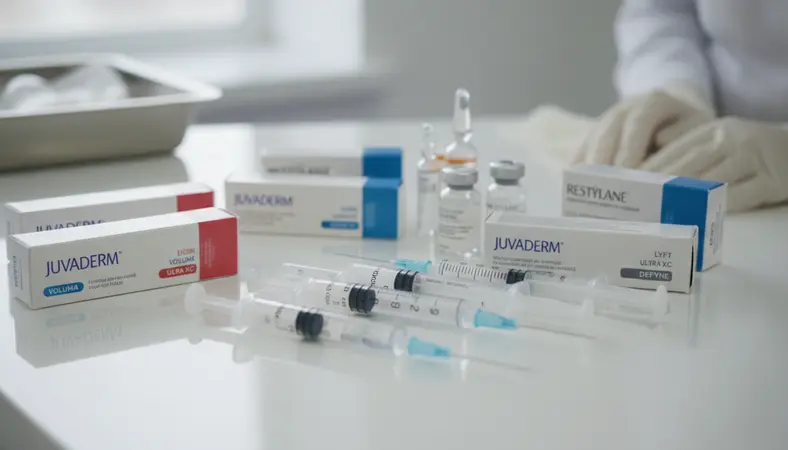
Hyaluronic acid (HA) fillers dominate the dermal filler market, accounting for approximately 80% of all filler procedures performed worldwide. Their popularity is well-deserved: HA fillers offer natural-looking results, predictable performance, excellent safety profiles, and the unique advantage of reversibility with hyaluronidase. However, the sheer number of HA filler products available—each with distinct rheological properties and clinical indications—can be overwhelming for practitioners. This guide provides a systematic overview of the major HA filler families and the science behind product selection.
Major HA Filler Families
Juvederm (Allergan/AbbVie)
The Juvederm collection is manufactured using Allergan's proprietary VYCROSS and Hylacross cross-linking technologies. VYCROSS technology blends high and low molecular weight HA chains, producing a smooth, cohesive gel with high lift capacity and extended duration. The Juvederm product line includes:
- Juvederm Voluma XC: The workhorse of midface volumization. High G-prime (firmness) makes it ideal for cheek augmentation, deep temple filling, and chin projection. Placed deep (supraperiosteal or subcutaneous) for structural support. Duration: up to 24 months.
- Juvederm Vollure XC: Medium G-prime filler designed for moderate-to-severe facial wrinkles and folds, particularly the nasolabial folds. Its balance of cohesivity and flexibility makes it versatile for multiple treatment areas. Duration: up to 18 months.
- Juvederm Volbella XC: Low G-prime, soft filler designed specifically for lip augmentation and perioral lines. Its low viscosity provides natural-feeling lip enhancement with minimal risk of visible lump formation. Duration: up to 12 months.
- Juvederm Ultra XC / Ultra Plus XC: Hylacross technology products that remain popular for lip augmentation (Ultra) and deeper folds (Ultra Plus). These were the original Juvederm products and continue to have a loyal following among experienced injectors.
Restylane (Galderma)
The Restylane family uses NASHA (Non-Animal Stabilized Hyaluronic Acid) and OBT (Optimal Balance Technology) manufacturing processes. NASHA produces a particulate gel with firm, defined tissue support, while OBT creates a smoother, more cohesive product. The Restylane line includes:
- Restylane Lyft: Firm, large-particle gel for midface volume restoration, cheek augmentation, and hand rejuvenation (the first HA filler FDA-approved for hands). Its firm consistency provides excellent lift capacity in areas requiring structural support. Duration: up to 18 months.
- Restylane Defyne: OBT technology produces a flexible, cohesive gel that maintains support while allowing natural facial movement. Ideal for nasolabial folds and marionette lines in patients who are highly expressive. Duration: up to 12 months.
- Restylane Refyne: Softer and more flexible than Defyne, designed for mild-to-moderate nasolabial folds and marionette lines. Excellent for patients who prioritize natural movement over maximal correction. Duration: up to 12 months.
- Restylane Kysse: Specifically designed for lip augmentation with XpresHAn Technology, providing flexible, natural movement in the lips. Duration: up to 12 months.
- Restylane Contour: Dynamic filler with XpresHAn Technology for cheek definition that adapts to facial movement. Duration: up to 12 months.
- Restylane Eyelight: Specifically formulated for the under-eye area (tear trough), with properties designed to minimize the Tyndall effect and provide smooth, even correction in this delicate area.
RHA Collection (Revance/Teoxane)
The RHA (Resilient Hyaluronic Acid) collection uses a unique manufacturing process that preserves the natural structure of HA chains, resulting in fillers that stretch and compress with facial movement rather than remaining rigid. This dynamic behavior makes RHA fillers particularly well-suited for areas with high mobility:
- RHA 2: Light, flexible filler for superficial lines and dynamic areas such as perioral rhytids and crow's feet
- RHA 3: Medium filler for moderate folds and wrinkles, particularly nasolabial folds in patients with animated expressions
- RHA 4: Firm filler for deep folds, volumization, and structural support in areas requiring significant lift capacity
- RHA Redensity: Specialized for the tear trough and periorbital area, with a formulation designed to integrate smoothly in the thin under-eye skin
Understanding G-Prime and Rheology
Rheology—the study of how materials deform and flow under stress—is the scientific framework for understanding why different fillers behave differently in tissue. The key rheological properties that differentiate HA fillers include:
G-prime (G'): Also called elastic modulus or storage modulus, G-prime measures a filler's resistance to deformation. A high G-prime filler is firm and resists compression, making it ideal for lifting and projecting (cheek augmentation, chin enhancement, nose reshaping). A low G-prime filler is soft and deforms easily, making it better suited for areas requiring natural movement and a soft feel (lips, under-eyes, superficial lines).
Cohesivity: Measures how well the gel holds together as a unified mass versus fragmenting into particles. High cohesivity fillers spread evenly and maintain smooth contours, while low cohesivity fillers may feel more granular and are more prone to irregularities.
Viscosity: Determines how easily the filler flows through the needle or cannula. Higher viscosity fillers require more injection force but tend to stay where placed. Lower viscosity fillers inject more easily but may have a greater tendency to migrate.
Hygroscopicity: The degree to which the filler absorbs water after injection. High hygroscopicity means the filler will swell more after placement, which must be accounted for during injection to avoid overcorrection.
Product Selection by Treatment Area
Matching the right filler to the right treatment area is one of the most important clinical skills in aesthetic injection. The following guidelines reflect current best practices:
- Cheeks/midface: High G-prime fillers (Voluma, Restylane Lyft, RHA 4) placed deep for structural volumization
- Temples: High G-prime fillers placed supraperiosteally in small boluses
- Nasolabial folds: Medium G-prime fillers (Vollure, Restylane Defyne, RHA 3) that balance support with flexibility
- Marionette lines: Medium G-prime fillers, often combined with jawline treatment for comprehensive lower face rejuvenation
- Lips: Low to medium G-prime fillers (Volbella, Restylane Kysse, Juvederm Ultra) that feel soft and natural
- Tear troughs: Specialized low G-prime, low hygroscopicity products (Restylane Eyelight, RHA Redensity, Belotero Balance) to minimize swelling and Tyndall effect
- Chin/jawline: High G-prime fillers for projection and definition
- Non-surgical rhinoplasty: High G-prime, high cohesivity fillers that maintain precise shape (Voluma, Restylane Lyft)
Cross-Linking Technology
All injectable HA fillers are cross-linked—meaning the HA polymer chains are chemically bonded together to form a stable gel matrix that resists enzymatic degradation. Without cross-linking, native HA would be absorbed within hours. The cross-linking agent used in virtually all commercial HA fillers is BDDE (1,4-butanediol diglycidyl ether).
The degree and method of cross-linking directly determine a filler's physical properties and longevity. Higher cross-linking generally produces firmer, longer-lasting fillers but also increases the risk of inflammatory reactions and may reduce tissue integration. Each manufacturer's proprietary technology optimizes the cross-linking process to achieve the desired balance of firmness, duration, cohesivity, and biocompatibility.
Reversibility with Hyaluronidase
One of the most significant safety advantages of HA fillers over other filler categories is their reversibility. Hyaluronidase (brand names include Hylenex and Vitrase) is an enzyme that breaks down hyaluronic acid, allowing practitioners to dissolve HA filler in emergency situations (vascular occlusion) or elective revision (overcorrection, asymmetry, undesirable results).
Understanding hyaluronidase dosing and protocols is essential safety knowledge for any practitioner who injects HA fillers. For emergency dissolution (suspected vascular occlusion), the recommended protocol involves injecting 200-300 units of hyaluronidase directly into the area of compromised vascular supply, with repeat dosing every 60-90 minutes as needed until vascular patency is restored. For elective dissolution, lower doses of 30-150 units per treatment area are typically sufficient, injected directly into the filler deposit.
Our Advanced Botox & Filler Training covers product selection, injection techniques, and complication management including hyaluronidase protocols, ensuring you have the comprehensive knowledge needed to use HA fillers safely and effectively across all treatment areas.