Botox and dermal fillers are the two pillars of non-surgical facial rejuvenation, together accounting for over 13 million procedures performed annually in the United States. Despite their ubiquity, significant confusion persists among both patients and new practitioners about the fundamental differences between these two treatment modalities. Understanding how each works, where each excels, and how they complement each other is foundational knowledge for any aesthetic practitioner.
Mechanism of Action Comparison
How Botox Works
Botox (onabotulinumtoxinA) is a neuromodulator that works by temporarily blocking the release of acetylcholine at the neuromuscular junction. When injected into specific facial muscles, it reduces or eliminates the repetitive muscle contractions that cause dynamic wrinkles—lines that appear during facial expression and eventually become etched into the skin at rest. Botox does not add volume or fill wrinkles; it relaxes the muscles that create them.
The onset of Botox typically begins within three to five days, with full effect reached at 10 to 14 days. The duration of action ranges from three to four months for most patients, though some individuals experience effects lasting up to six months with repeated treatments. Other neuromodulators in the same category include Dysport (abobotulinumtoxinA), Xeomin (incobotulinumtoxinA), Jeuveau (prabotulinumtoxinA), and Daxxify (daxibotulinumtoxinA), which has a reported duration of up to six months.
How Dermal Fillers Work
Dermal fillers are injectable gel substances that physically occupy space beneath the skin, restoring lost volume, filling static wrinkles and folds, and enhancing facial contours. Unlike Botox, fillers have no effect on muscle activity. They work by adding volume where it has been depleted due to aging, gravity, or congenital anatomy.
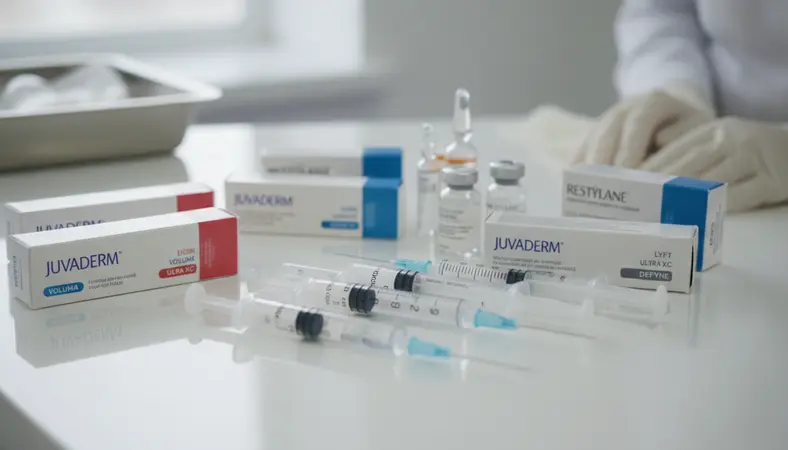
The most commonly used fillers are based on hyaluronic acid (HA), a naturally occurring polysaccharide found throughout the human body. HA fillers include the Juvederm, Restylane, and RHA product families. Other filler categories include calcium hydroxylapatite (Radiesse), poly-L-lactic acid (Sculptra), and polymethylmethacrylate (Bellafill). Each category has distinct properties, indications, and longevity profiles.
Treatment Areas for Each
Botox Treatment Areas
Botox excels in treating areas where dynamic muscle activity is the primary cause of wrinkles:
- Glabellar complex (frown lines): The procerus and corrugator supercilii muscles create the vertical "11" lines between the eyebrows. This is the most commonly treated Botox area and the only FDA-approved cosmetic indication for all neuromodulators.
- Forehead lines: Horizontal lines created by the frontalis muscle are treated with carefully distributed Botox to smooth wrinkles while preserving natural brow movement and position.
- Crow's feet: The orbicularis oculi muscle creates radiating lines at the lateral corners of the eyes during smiling. Botox softens these lines while maintaining a natural smile.
- Bunny lines: Lines on the lateral nose from the nasalis muscle.
- Lip flip: Small doses in the orbicularis oris roll the upper lip slightly outward, creating the appearance of fuller lips without filler.
- Masseter (facial slimming): Botox reduces the bulk of the masseter muscle, creating a slimmer jawline appearance.
- Platysmal bands: Vertical neck bands caused by platysma muscle hyperactivity.
Dermal Filler Treatment Areas
Dermal fillers excel in areas where volume loss or structural deficiency is the primary concern:
- Cheeks and midface: Restoring malar volume lost through aging reverses the flattened, descended appearance of the midface. Deep filler placement recreates the youthful cheek convexity.
- Nasolabial folds: The deep creases running from the nose to the corners of the mouth are one of the most common filler treatment areas.
- Marionette lines: Vertical lines running from the mouth corners toward the chin create a sad or angry expression that fillers can effectively soften.
- Lips: Lip augmentation with HA fillers is one of the fastest-growing aesthetic procedures, addressing both volume and border definition.
- Tear troughs: Under-eye hollowing creates a tired, aged appearance that can be carefully corrected with specialized fillers.
- Temples: Temporal volume loss is one of the earliest signs of facial aging and responds well to deep filler placement.
- Chin and jawline: Fillers can enhance projection, define the jawline, and improve overall facial proportions.
- Non-surgical rhinoplasty: Small amounts of filler can camouflage dorsal humps, lift the tip, and improve nasal symmetry.
Product Longevity
The duration of results differs substantially between Botox and dermal fillers, and varies within each category depending on the specific product used:
- Botox/Dysport/Xeomin/Jeuveau: 3-4 months
- Daxxify: 4-6 months
- HA fillers (lips): 6-12 months
- HA fillers (midface/cheeks): 12-18 months
- HA fillers (deep structural): 12-24 months
- Radiesse: 12-18 months
- Sculptra: 2+ years (with typical 2-3 session protocol)
- Bellafill: 5+ years (semi-permanent)
Cost Comparison
Cost structures for Botox and fillers differ significantly, which affects both patient decision-making and practice revenue models:
Botox is typically priced per unit, with national averages ranging from $10 to $20 per unit. A standard treatment for the three most common areas (glabella, forehead, crow's feet) uses 40-64 units total, resulting in a per-visit cost of $400 to $1,200. Since treatments are repeated every three to four months, the annual cost ranges from $1,200 to $4,800.
Dermal fillers are priced per syringe, with costs ranging from $600 to $1,200 per syringe depending on the product. Most treatment areas require one to three syringes per session. A comprehensive full-face filler treatment may require four to eight syringes ($2,400 to $9,600), though touch-ups and maintenance sessions typically require less product. The longer duration of fillers means that annual costs may be comparable to or lower than Botox for some patients, despite the higher per-visit cost.
Combination Approaches
The most comprehensive facial rejuvenation results come from combining Botox and fillers in a strategic treatment plan often referred to as a "liquid facelift" or "non-surgical facelift." This approach leverages the strengths of each modality:
Botox addresses the upper face (forehead lines, frown lines, crow's feet) where dynamic muscle activity is the dominant aging factor, while fillers address the mid and lower face (cheeks, nasolabial folds, marionette lines, lips, jawline) where volume loss is the primary concern. Together, they create a harmonious, refreshed appearance that looks natural rather than "done."
Many practitioners perform both Botox and filler in a single appointment, starting with Botox in the upper face and proceeding to filler in the mid and lower face. This efficiency is valued by patients and practice profitability. Treatment plans can also be staged over multiple visits for patients who prefer a more gradual approach or have budget constraints.
Choosing the Right Treatment
The decision between Botox, fillers, or a combination should be guided by a thorough facial analysis and understanding of the patient's specific aging concerns. A simple clinical framework: if the wrinkle or concern is caused by muscle movement (dynamic wrinkles), Botox is the appropriate treatment. If the concern is caused by volume loss, structural deficiency, or static lines that persist at rest, fillers are indicated. Most patients over 35 benefit from some combination of both.
Developing proficiency in both modalities is essential for any aesthetic practitioner who wants to offer comprehensive care. Our Botox Certification Course provides foundational neurotoxin training, while our Advanced Botox & Filler Training covers both modalities at an advanced level, including combination treatment planning and full-face rejuvenation strategies.