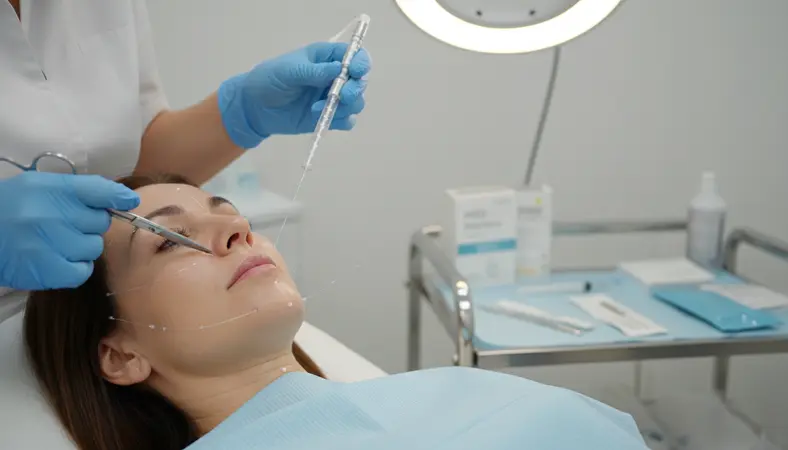
The most natural and comprehensive facial rejuvenation results often come from combining multiple treatment modalities rather than relying on a single approach. PDO thread lifts and dermal fillers address fundamentally different aspects of facial aging—threads reposition descended tissue and stimulate collagen, while fillers restore lost volume and contour. When used together strategically, these treatments produce synergistic results that exceed what either can achieve alone. However, combining these modalities requires careful planning regarding treatment sequencing, timing, anatomical safety zones, and patient selection.
Treatment Sequencing: Threads First or Fillers First?
The question of whether to perform threads or fillers first is one of the most debated topics in combination aesthetic therapy, and the answer depends on the individual patient's anatomy and treatment goals. Both approaches have valid clinical rationale, and experienced practitioners develop a preference based on their clinical experience and technique.
The Case for Threads First
Many practitioners prefer to perform PDO thread lifting before filler injection, and this is the most commonly recommended approach. The rationale is straightforward: by repositioning descended tissue first, you re-establish the structural framework of the face and reduce the total amount of filler needed. A patient who appeared to need significant volume restoration in the midface may, after thread lifting, require only modest filler augmentation once the malar fat pad has been elevated to its more youthful position.
When threads are placed first, fillers are typically added four to six weeks later, once the initial swelling from the thread procedure has resolved and the tissue has settled into its new position. This waiting period allows the practitioner to accurately assess the remaining volume deficit and place filler precisely where it is needed rather than guessing how much the threads will ultimately lift.
The Case for Fillers First
Some practitioners prefer to place fillers first, particularly when deep structural volume loss is the predominant concern. In patients with significant midfacial deflation, establishing a volumetric foundation with deep filler placement (at the supraperiosteal level) can provide a structural base that helps support and anchor thread placement at a later date. This approach is particularly relevant in patients with severe malar volume loss or deep tear trough deformities.
If fillers are placed first, a minimum four-week interval before thread insertion is recommended to allow the filler to fully integrate with the tissue. This reduces the risk of filler migration or displacement during thread insertion and allows the practitioner to assess the filler result before adding the mechanical lift component.
Synergistic Effects
The combination of PDO threads and dermal fillers creates a comprehensive rejuvenation approach that addresses multiple layers and mechanisms of facial aging simultaneously:
- Structural repositioning + Volume restoration: Threads lift and reposition descended soft tissue while fillers replace volume lost through fat pad atrophy and bone resorption. Together, they recreate the three-dimensional facial contour of a more youthful face.
- Collagen stimulation + Immediate volume: PDO threads stimulate neocollagenesis over three to six months, providing progressive tissue quality improvement, while fillers provide immediate visible volume correction. The patient enjoys instant results that continue to improve as the threads' biostimulatory effects develop.
- Mechanical support + Soft tissue augmentation: Thread scaffolding provides structural support that helps maintain filler position and longevity. Fillers placed in tissue that has been lifted and supported by threads tend to remain in their intended position longer than fillers placed in tissue that continues to descend.
- Extended results: The combination often produces results that last longer than either treatment alone, as the collagen produced by PDO thread absorption continues to provide structural support even after the threads have fully dissolved at six to eight months.
Anatomical Considerations and Safety Zones
When combining threads and fillers, meticulous attention to anatomy is essential to avoid complications. Several key anatomical considerations guide safe treatment planning:
Tissue Plane Separation
Threads and fillers should ideally be placed in different tissue planes to minimize interaction and complication risk. PDO cog threads are typically placed in the subcutaneous layer or the superficial musculoaponeurotic system (SMAS), while deep volumizing fillers are placed supraperiosteally or in the deep fat compartments. This spatial separation reduces the risk of threads disrupting filler placement and vice versa.
Vascular Safety
Both thread insertion and filler injection carry vascular risks, and combining the procedures compounds this concern. Critical danger zones include the temporal artery and its branches (risk during temporal anchoring of threads), the angular artery along the nasolabial fold, the facial artery at the mandibular border, and the supratrochlear and supraorbital vessels in the forehead. The practitioner must have an thorough understanding of facial vasculature and maintain awareness of these structures during both procedures. Our Cadaver Lab Injection Anatomy course provides unparalleled hands-on learning of facial vascular anatomy in a clinical setting.
Avoiding Thread-Filler Interaction
When fillers are injected in close proximity to existing PDO threads, several issues can arise. Needle or cannula insertion may displace or damage the threads, reducing their lifting effect. Filler placed adjacent to threads may create irregular contours as the tissue remodels. Inflammatory responses from each material may interact unpredictably. Maintaining spatial separation (different tissue planes and at least 1cm lateral distance between thread tracts and filler deposits) minimizes these risks.
Timing Between Procedures
Proper timing between thread and filler procedures is critical for safety and optimal results. The following timeline provides a general framework:
- Same-day combination: While some experienced practitioners perform both procedures in a single session, this approach carries higher risk of complications including increased swelling, bruising, and the potential for filler migration due to tissue manipulation from thread insertion. Same-day treatment should only be considered by highly experienced practitioners and typically involves placing threads first, followed by conservative filler injection in anatomically distant areas.
- 2-4 week interval: A two to four-week interval is the minimum recommended separation between procedures. This allows initial swelling to resolve and provides early assessment of the first procedure's results.
- 4-6 week interval (recommended): A four to six-week interval between procedures is considered optimal by most experts. This allows complete resolution of post-procedural inflammation, full tissue settling after thread placement, and accurate assessment of remaining volume needs before filler injection.
Clinical Approach by Case Type
Mild laxity with moderate volume loss: Begin with fillers to restore structural volume, particularly in the temples, midface, and chin. Follow with smooth PDO threads at four to six weeks for skin tightening and collagen stimulation. This patient may not need cog threads at all.
Moderate laxity with mild volume loss: Begin with cog thread lifting to reposition tissue. Reassess at four to six weeks and add targeted filler to address any remaining volume deficits, particularly in the nasolabial folds, marionette lines, and lips.
Significant laxity with significant volume loss: These patients benefit most from the full combination approach. Consider deep volumizing filler first (temple, midface, chin), followed by cog thread lifting at four to six weeks, and potentially a final touch-up filler session at eight to twelve weeks for refinement of the result.
To develop expertise in combining PDO threads with fillers, our Advanced PDO Thread Certification course covers multimodal treatment planning, and our Advanced Botox & Filler Training provides the filler injection skills needed for comprehensive facial rejuvenation.