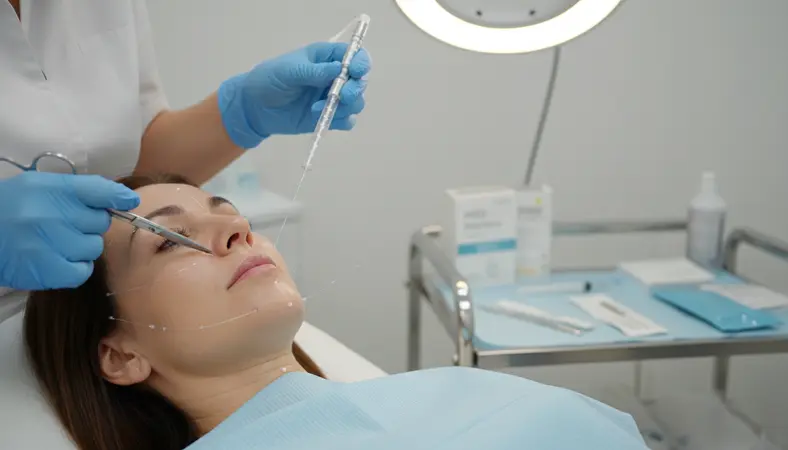
Polydioxanone (PDO) thread lifting has become one of the most in-demand minimally invasive procedures in aesthetic medicine, offering practitioners a versatile tool for facial and body rejuvenation. However, the sheer variety of PDO thread types, gauges, configurations, and brands available can be overwhelming for practitioners entering this field. Selecting the right thread for each treatment area is not merely a technical decision—it directly determines clinical outcomes, patient satisfaction, and safety. This guide provides a systematic approach to PDO thread selection based on treatment goals and anatomical considerations.
Understanding PDO Thread Types
Smooth (Mono) Threads
Smooth threads, also called mono threads, are the simplest form of PDO thread. They consist of a single, unadorned strand of polydioxanone attached to a sharp or blunt-tipped needle. Smooth threads do not provide mechanical lifting. Instead, they work primarily through biostimulation—the thread acts as a scaffold that stimulates neocollagenesis (new collagen formation) along its path as the body responds to the foreign material. Over the subsequent three to six months, the thread dissolves completely while the collagen matrix it stimulated remains, providing improved skin quality, firmness, and texture.
Smooth threads are best suited for skin tightening and rejuvenation in areas where lifting is not the primary goal. Common applications include the perioral region, neck, decolletage, under-eye area, and areas of fine crepey skin on the body. They are frequently placed in a mesh or cross-hatch pattern to create a uniform collagen scaffold.
Screw (Twisted) Threads
Screw threads consist of one or two smooth PDO strands wound helically around the insertion needle. This coiled configuration creates a greater surface area and more robust collagen stimulation than a single smooth thread. Screw threads provide moderate volumizing effect in addition to skin tightening, making them ideal for areas that need both textural improvement and subtle volume restoration, such as the nasolabial folds, marionette line area, and hollow cheeks.
Barbed (Cog) Threads
Barbed threads, commonly called cog threads, feature directional barbs cut or molded into the PDO strand. These barbs anchor into the subcutaneous tissue, allowing the thread to mechanically lift and reposition sagging tissue. Cog threads are the workhorse of PDO thread lifting and are used whenever a visible lifting effect is the primary treatment goal.
Cog threads come in several barb configurations:
- Unidirectional cogs: Barbs face a single direction, providing lift in one vector. These require an anchoring point (typically at the temporal hairline or zygomatic arch) and are best for strong linear lifting of the midface or jowls.
- Bidirectional cogs: Barbs face in opposite directions from a central convergence point. These threads are self-anchoring—the opposing barbs grip tissue from both directions—and are easier to place but provide slightly less lifting force than unidirectional designs.
- Molded cogs: The barbs are formed by molding the PDO material rather than cutting into it, preserving the structural integrity of the thread. These tend to be stronger and more resistant to breakage during insertion.
- Cut cogs: The barbs are created by cutting into the thread strand, which can reduce the overall tensile strength. However, cut cogs often provide more aggressive tissue grip due to sharper barb edges.
Thread Gauge Selection
PDO threads are available in various gauges (diameters), and selecting the appropriate gauge for each treatment area is critical for both efficacy and safety. Thread gauge is expressed using the USP (United States Pharmacopeia) suture sizing system, where higher numbers indicate finer threads.
- 29-30 gauge (6-0 to 7-0): Ultra-fine threads used for delicate areas such as the periorbital region, lips, and fine lines. These produce subtle biostimulation with minimal risk of visible irregularities.
- 26-27 gauge (5-0 to 6-0): Fine-gauge threads commonly used for smooth and screw thread applications in the lower face, neck, and perioral area. These provide good collagen stimulation while maintaining a low risk profile.
- 21-23 gauge (3-0 to 4-0): Medium-gauge threads used for barbed/cog threads in the midface and jawline. These provide meaningful tissue grip and lifting force appropriate for moderate laxity.
- 18-19 gauge (1 to 2-0): Heavy-gauge threads used for maximal lifting in areas with significant tissue weight, such as the jowls, neck, and body applications. These provide the strongest anchoring but require more precise placement to avoid complications.
Thread Selection by Treatment Area
Midface and Cheeks
The midface is the most common area for PDO thread lifting and typically requires barbed cog threads in 19-21 gauge (2-0 to 3-0) with lengths of 60-90mm. Unidirectional cog threads anchored at the temporal hairline provide the strongest vertical lift vector for the malar fat pad and nasolabial fold. Most practitioners place 2-4 threads per side, fanning them to create a broad lifting effect. Bidirectional cog threads can also be used for patients with mild-to-moderate laxity who desire a more subtle result.
Jawline and Jowls
Jawline definition requires cog threads placed along vectors that lift the jowl tissue superiorly and posteriorly toward the ear. Heavy-gauge threads (18-19 gauge, 1 to 2-0) with bidirectional barbs are effective here, placed from the jowl area toward the preauricular region. Typically 2-3 threads per side are sufficient. For enhanced jawline definition, some practitioners combine cog threads with a row of smooth mono threads placed along the mandibular border to tighten the overlying skin.
Neck
The neck presents unique challenges due to thin skin, high mobility, and the risk of thread visibility. Smooth mono threads (26-29 gauge, 5-0 to 7-0) placed in a cross-hatch pattern are the safest and most effective approach for neck rejuvenation, providing skin tightening and collagen stimulation without the risks associated with barbed threads in this mobile area. For patients with platysmal bands, cog threads may be used selectively, but this is an advanced technique requiring careful anatomical knowledge.
Body Applications
PDO threads are increasingly used for body applications including the arms, abdomen, inner thighs, and buttocks. Body applications typically require the heaviest gauge threads available (18-19 gauge) with long lengths (100-150mm) to achieve meaningful tissue repositioning. Both cog threads for lifting and smooth threads for skin tightening are used in body treatments, often in combination.
Brand Comparisons and Considerations
The PDO thread market includes numerous manufacturers, each offering products with distinct characteristics. When evaluating thread brands, consider the following factors:
- Material quality: Not all PDO is created equal. Premium threads are manufactured from medical-grade polydioxanone with consistent tensile strength and predictable absorption profiles. Lower-quality threads may exhibit inconsistent barb geometry, premature degradation, or increased inflammatory response.
- Barb design: The depth, angle, and spacing of barbs vary significantly between manufacturers and directly affect tissue grip strength and insertion smoothness. Molded barbs tend to maintain thread integrity better than cut barbs.
- Needle quality: The insertion needle (cannula or sharp) should be sharp, smooth, and appropriately sized for the thread. Dull or rough needles increase tissue trauma and patient discomfort.
- FDA clearance: Ensure that any PDO thread product you use has appropriate FDA clearance for its intended use. Using non-cleared products exposes you to regulatory and liability risks.
- Training and support: Leading thread manufacturers offer practitioner training programs, clinical support, and marketing materials. This support can be valuable, especially for practitioners new to thread lifting.
Our PDO Thread Lift Training course provides hands-on experience with multiple thread systems, allowing you to compare products directly and develop preferences based on clinical performance. For practitioners ready to expand into advanced techniques, our Advanced PDO Thread Certification covers complex multithread protocols and body applications.